


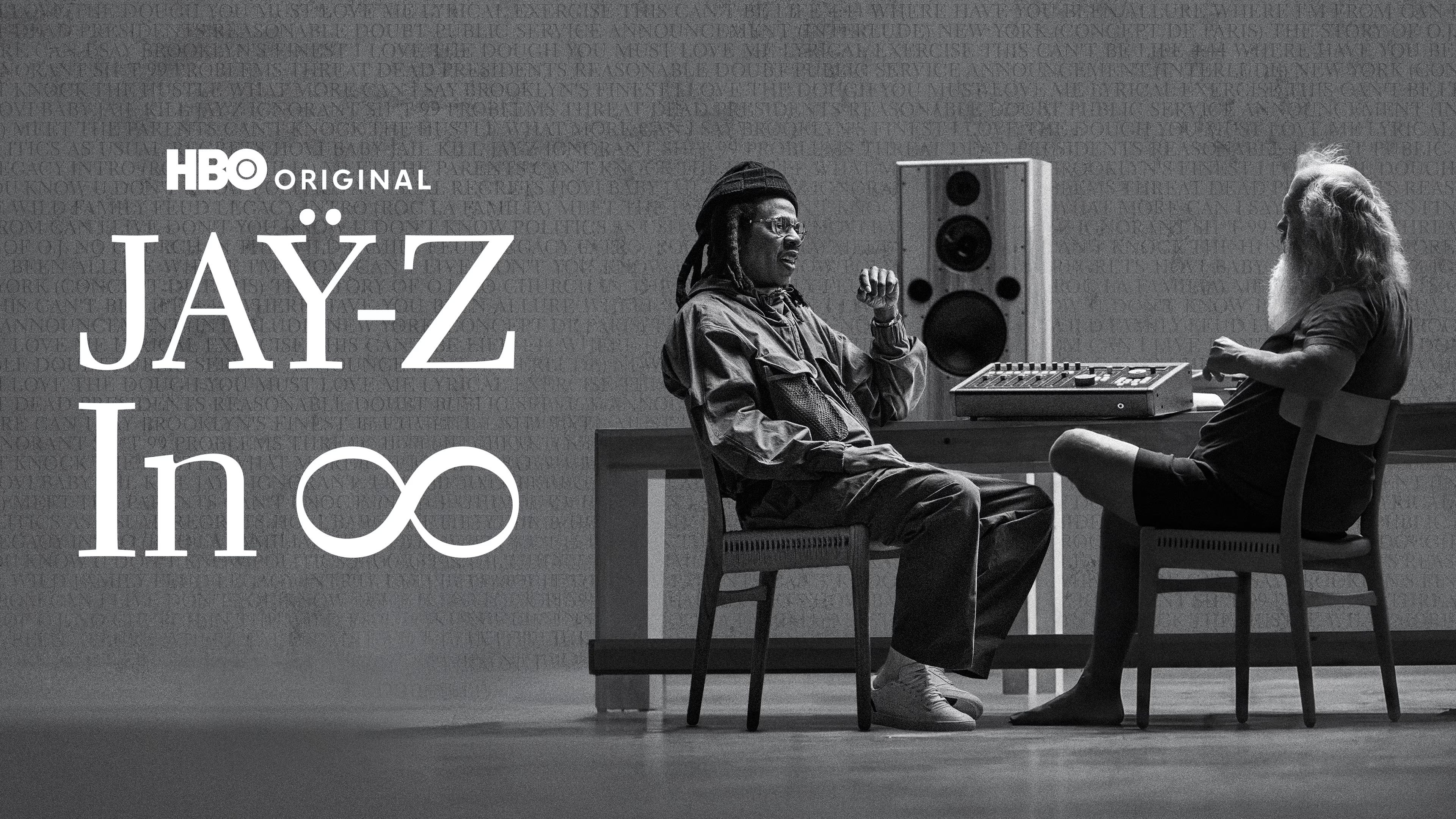
JAŸ-Z in 8 arrived on HBO Max on Friday, September 18, and by Sunday it had been processed twice over — once by hip-hop media, which mined it for extractable items, and once by television critics, who reviewed it as a film and found it wanting. The series is the most granular account Jay-Z has ever given of his own work. It is also, by design, almost impossible to cover. What follows is less a review than a look at what happened to the thing after it landed.
What Actually Dropped
The format is unusual enough to explain first. JAŸ-Z in 8 is an eight-part HBO Max series built as an extended conversation between Jay-Z and Rick Rubin, who directs. Daniel Kaluuya is credited as an executive producer. Two episodes premiered on September 18, with two more arriving each Friday until a double finale on October 9. [Tom’s Guide]
Each episode organizes itself around a single song — “Dynasty Intro,” “Meet the Parents,” “Can’t Knock the Hustle,” “What More Can I Say,” “Brooklyn’s Finest,” “I Love the Dough,” “Lyrical Exercise,” “This Can’t Be Life” — though the conversation reportedly wanders across roughly two dozen more, including “4:44,” “99 Problems,” and “The Story of O.J.” [Rolling Out] Total runtime runs past seven hours. There is no narrator, no archival montage doing structural work, no third party to push back. It is two men and a catalog. [Complex]
That choice matters more than it sounds. Jay-Z has sat for plenty of interviews and authorized plenty of documentaries. He has never before submitted his own lyrics, line by line, to sustained public annotation — and he has never done it in a format where he sets the pace.
The Revelation Economy
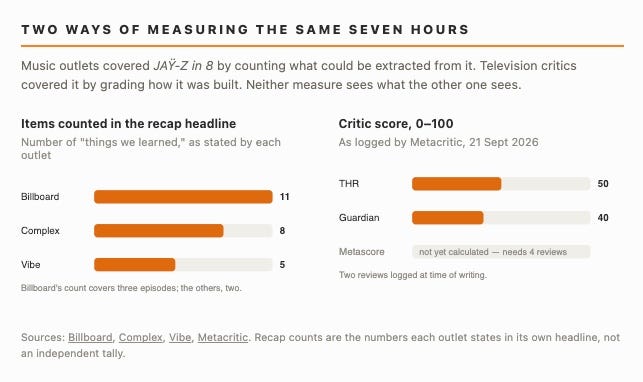
Here is the tell. Within four days, the three biggest music outlets covering the premiere all filed the same piece, and all three put a number in the headline. Complex ran 8 Things We Learned From the First Two Episodes. [Complex] Vibe ran 5 Things We Learned. [Vibe] Billboard went further and counted eleven, across three episodes. [Billboard]
HotNewHipHop took the other approach and atomized it — splitting individual moments into standalone posts, so that Jay-Z’s account of the Biggie and Tupac fallout ran as its own news item rather than as bullet four of eleven. [HotNewHipHop] TheGrio did the same with the same segment two days later. [TheGrio]
Nobody was wrong to do this. A seven-hour conversation with no narrative spine does not reduce to a 900-word review; it reduces to a list. But notice what the format selects for. A moment becomes coverable when it can be stated in one sentence and survives being pulled out of the room it was said in. The parts of the series that do not compress — the long stretches about craft, sequencing, why a verse got cut — leave no trace in the coverage at all. Seven hours of a man explaining his own work became roughly twenty-four quotable sentences.
What He Actually Said
The items that did survive extraction are, mostly, about money and ambivalence rather than about beef.
The origin story he gives is a contract. Watching Jaz-O sign a $400,000 recording deal with EMI in 1988 is what converted rap, in his head, from something happening on the block into a job with a number attached. [Complex] The first rap record he ever heard came out of his mother Gloria Carter’s collection — the Fatback Band’s “King Tim III (Personality Jock),” which is a more interesting answer than “Rapper’s Delight” precisely because it is the less canonical one.
More striking is what he says about wanting the job at all. By his own account he did not love being an artist, and went in planning to release a single album and move into management on the Russell Simmons model. [Complex] Thirty years of catalog later, that reads less like false modesty than like the origin of a particular temperament: the executive was always the primary instinct, and the rapping was the leverage.
The craft notes run the same direction. He delays rehearsal until days before a show, on the theory that over-preparation disengages him. He still thinks The Black Album was mis-rolled out and that “Encore” should have led instead of “Change Clothes.” Twenty-three years on, a man with nothing left to prove is still relitigating a single choice. That is not a revelation. It is a disposition, and it explains more about the career than any of the numbered items do.
The “Brooklyn’s Finest” Edit
The segment that traveled furthest is Jay-Z’s account of how the friendship between The Notorious B.I.G. and Tupac Shakur came apart — and it needs to be handled as what it is: one participant’s recollection, roughly thirty years after the fact, of events involving two men who cannot respond.
As he tells it, Biggie warned Tupac about people in his orbit; Tupac relayed the warning to those same people, which put Biggie in a difficult position back in New York. After the 1994 Quad Studios shooting, in which Tupac was robbed and shot and survived, Tupac publicly implicated Biggie and Sean Combs — an accusation both men denied at the time and which has never been established. [TheGrio] Jay-Z’s reading is that Tupac understood Biggie had tried to protect him and blamed him anyway for not preventing it. [HotNewHipHop] None of that is documented fact; it is his account of other men’s states of mind, and should be read that way.
What is checkable, and more interesting, is the editorial decision he cops to. On “Brooklyn’s Finest,” he says he asked Biggie to remove a line referencing Carolina — a West Coast-adjacent provocation — specifically to keep the temperature down. [Complex] A 26-year-old rapper on his debut album, already thinking about consequence management on someone else’s verse.
His summary of what followed is the most quoted line of the premiere weekend: “It took on a life of its own. Magazines started picking it up. It became this thing where everybody was involved.” [HotNewHipHop] He is describing media amplification turning a private falling-out into a coastal war. He is describing it in a docuseries that was, that same weekend, being amplified into numbered lists. The irony is not subtle, and he is almost certainly aware of it.
The Critics’ Ledger
While the music press counted revelations, the television press counted structure — and came up short. The Hollywood Reporter’s Daniel Fienberg scored it 50, with the core objection that “without delineated chronology or themes, JAŸ-Z in 8 never feels like it’s building to anything.” The Guardian’s Shaad D’Souza scored it 40 and argued the show should have been a podcast. As of this writing Metacritic has only those two reviews logged and will not calculate a Metascore until it has four. [Metacritic]
Variety landed in the same neighborhood from a friendlier angle, framing the series as illuminating and possibly too thorough. [Variety] The Hollywood Reporter’s own headline settled on “impresses and exasperates in equal measure.” [The Hollywood Reporter]
Every one of those complaints is accurate. None of them is a complaint the series would recognize as one.
Why the Two Readings Diverge
The critics are grading a documentary. The series is not one. A documentary makes an argument about its subject; it selects, sequences, contradicts, withholds. JAŸ-Z in 8 does none of that, and the absence is deliberate. Rubin’s entire practice as an interlocutor — in the studio, on his podcast, in his book — is to sit still and let a person arrive somewhere on their own. Applied to eight hours of television, that method produces exactly what Fienberg describes: something that never builds, because building was never the goal.
“It should have been a podcast” is meant as a dismissal. It is closer to a description of the commission. What HBO bought was the archive, not the edit.
Which raises the question the reviews don’t ask: who is this actually for? Not the casual viewer — the Guardian is right that a listener without deep catalog knowledge will be lost. Not the news cycle, which chewed through the usable material in a weekend. The audience for a seven-hour line-by-line is the person who will scrub back to a specific minute in five years to find out what he said about a specific bar. That is not a television audience. That is a reference audience.
The Thing He’s Actually Building
Jay-Z has spent twenty years moving upstream of every intermediary in his business — from label artist to label owner, from touring act to touring company, from streaming customer to streaming proprietor. The consistent move is not “get rich.” It is get in front of the thing that explains you to other people.
An eight-episode annotated catalog, directed by a friendly collaborator, released on his own schedule, is that same move applied to interpretation itself. For thirty years the meaning of these songs has been assembled by journalists, biographers, Genius annotators, documentarians, and litigants. This is the first version where the author holds the pen and the running time.
The cost is the thing critics are grading down: without an adversary in the room, the record that gets made is the record he wants. Nobody asks the hard follow-up. The absences — and there are absences — go unremarked because the format has no mechanism for remarking on them. You get the annotated catalog, and you get it at his tempo, and what he leaves out stays out.
That is a trade, not a failure. It is worth naming as a trade.
The Ledger He’s Keeping
Six more episodes land across the next three Fridays, closing October 9. The pattern is set: the music press will count, the TV press will grade, and neither number will describe the object.
What Jay-Z has made is a deposition — voluntary, unhurried, uncontested, filed into the permanent record while he is alive to give it. Hip-hop has lost too many of its principals before anyone thought to ask them anything, and the ones who survived have mostly had their stories told by other people. He is declining that. He is also, in a series about how a magazine cycle turned two friends into a war, watching the same machinery reduce his seven hours to eleven bullet points — and going ahead with it anyway.
He knows how the coverage works. He built the thing to outlast it.