


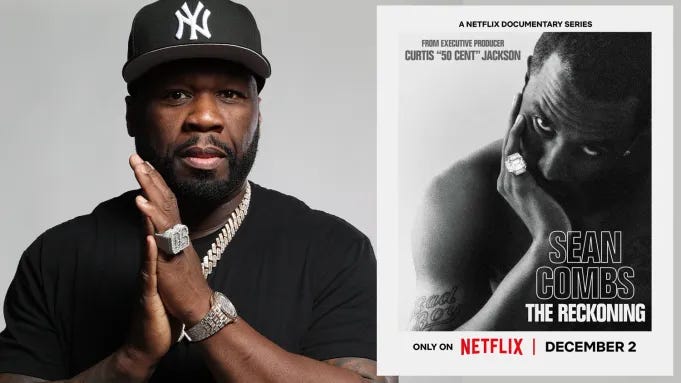
From Diss Tracks to a Documentary: How 50 Cent and Diddy’s Long Game Turned Into a Cultural Reckoning
For almost two decades, the tension between Sean “Diddy” Combs and Curtis “50 Cent” Jackson has hovered in the background of hip-hop like a low, electrical hum—always present, rarely addressed head-on, and often dismissed as just another celebrity beef. But the truth is more layered. What started as a jarring accusation on a 2006 diss track slowly grew into an ideological fault line, sharpened by business rivalries, uncomfortable personal interactions, and a decade of trolling that many chalked up to 50’s brand of chaotic humor.
Then the dam broke.
Legal allegations reshaped the cultural conversation around Diddy, federal raids hit his homes, and suddenly the feud wasn’t background noise anymore. It became a lens—one that explains how we got a four-part Netflix docuseries, Sean Combs: The Reckoning, with 50 Cent sitting in the executive producer chair.
This is the through-line.
This is how we got here.
I. The Line That Set Everything In Motion
To understand the weight of this feud, you have to start with the line—the one lyric that cracked open a fault that would never really close.
In 2006, on the diss track “The Bomb,” 50 Cent didn’t simply clown Diddy or jab at his business moves. He crossed into sacred territory, alleging that Diddy knew who was responsible for the still-unsolved murder of The Notorious B.I.G. It wasn’t subtle. It wasn’t coded. And it wasn’t the kind of allegation hip-hop usually lets slide.
This wasn’t a punchline.
It was a scarlet statement tied to one of the culture’s deepest wounds.
Diddy denied it then. He denies it now. But the effect was irreversible. After that track, the relationship between the two moguls changed shape. It never returned to neutral.
And whether fans saw it or not, that moment planted the seed for what would eventually become the documentary.
II. A Decade of Tension, Jokes, and Strange Energy
After the diss, the feud didn’t explode. It simmered—slow, strange, almost surreal. For the next ten years, the tension played out in the margins: interviews, red carpets, club appearances, and most prominently, 50’s ongoing trolling campaign that turned Diddy into a recurring character in his feed.
To the casual observer, it looked like jokes.
But to 50, it was a running critique.
He went at Diddy’s image, his age, his music, his style, even the energy he felt in the room around him. He later recalled a moment where Diddy allegedly offered to take him shopping—a gesture 50 publicly framed as “weird energy” that made him uncomfortable. Whether people believed him or not, that story became part of the lore.
Meanwhile, the two men built competing empires:
Cîroc on Diddy’s side, Effen on 50’s.
A mogul-off and a liquor war all in one.
Diddy publicly pretended there was no beef. In interviews, he’d smile, shrug, and say things like, “He loves me.” Like the tension was imaginary. Like everything was fine.
But the dynamic was real.
It just hadn’t reached its breaking point yet.
III. The Breaking Point Arrives
The shift came brutally and fast.
In November 2023, Cassie Ventura—Diddy’s former partner—filed a lawsuit alleging rape, abuse, and years of violent control. The suit settled within 24 hours, but the effect was seismic. More civil suits followed, each bringing fresh claims. Then, in March 2024, federal agents raided Diddy’s homes in Los Angeles and Miami, searching for evidence tied to an investigation whose full details have not been publicly disclosed.
Hip-hop has weathered scandals before.
But this felt different.
The silence around Diddy’s empire began to fracture.
And 50 Cent did not hesitate. He took to social media with a message that went viral instantly: “Now it’s not Diddy do it, it’s Diddy done. They don’t come like that unless they got a case.”
For him, this wasn’t just a moment—it was validation. A turning of the tide. Proof, in his eyes, that the concerns he had voiced for years were no longer jokes.
This was the moment where the story flipped.
The feud wasn’t entertainment anymore.
It became a reckoning.
IV. 50 Decides to Tell the Story Himself
The announcement came quickly: 50 Cent would executive produce a documentary chronicling the allegations and the people who had long claimed their stories were ignored.
He framed it not as revenge, but responsibility.
“If someone’s not saying something,” he argued, “then you would assume that everybody in hip-hop is okay with what’s going on.”
It was a striking message—especially coming from a man who built a reputation on provocation, not public advocacy.
But 50 saw an opportunity to use the tools he had mastered—social media, storytelling, and public spectacle—to build something that felt bigger than a beef. He didn’t make himself the star of the story. He made himself the megaphone.
Whether people agreed with his motives or not, he had positioned himself squarely as the catalyst.
V. The Doc Drops—and Sparks Another War
When Sean Combs: The Reckoning hit Netflix, the response was immediate and polarizing.
Diddy’s legal team blasted it as a biased project built on “a personal vendetta” from a longtime adversary. They claimed the series used “stolen footage” Diddy had been collecting since he was 19, allegedly meant for a documentary he planned to control himself.
The filmmakers pushed back hard.
They said the footage was “legally obtained.”
They emphasized that 50 Cent wasn’t the creative decision-maker.
Netflix denied any previous negotiations with Diddy about a doc.
This wasn’t just a fight about content.
It was a fight about narrative control.
Who gets to tell the story of Sean Combs?
The man?
The people accusing him?
Or the culture that watched it all unfold in real time?
The doc raised that question louder than ever.
VI. Inside the Documentary’s Most Shocking Allegations
The series featured testimony and footage that had never been seen publicly. Each claim is an allegation, not a confirmed fact—but together, they formed the backbone of the documentary’s impact:
Pre-arrest footage showing Diddy strategizing media manipulation.
Kirk Burrowes’ claims about alleged violence he says he witnessed, including incidents involving Diddy’s mother and Misa Hylton.
A controversial allegation that Diddy insisted on keeping Biggie in L.A., “ushering him to his death.”
A sex worker’s testimony describing alleged years-long involvement with Diddy and Cassie.
Claims of PR manipulation during Diddy’s legal proceedings.
Handled carefully, these moments weren’t just revelations—they were indictments of the power structure that had long protected Diddy from serious scrutiny.
VII. What This Feud Really Represents
In the end, the 50 vs. Diddy saga isn’t really about jokes, trolling, vodka, or viral moments. Those were symptoms. The documentary forced the culture to confront the question beneath it all:
What happens when one of hip-hop’s untouchable architects faces a public reckoning—and the person pushing that reckoning is someone who’s been clowning him for 20 years?
It’s messy.
It’s contradictory.
It’s compelling.
And it says something uncomfortable about the moment we’re living in:
The culture is changing.
Accountability is changing.
The old rules around power no longer hold the same weight.
Director Alexandria Stapleton put it perfectly: the doc is a “mirror.” Not just for Diddy, but for us—for how we treat fame, how we process allegations, and how we decide when to stop looking away.
This feud began with a diss track.
It ended with a documentary.
And somewhere in between, it became a case study in how hip-hop confronts its giants—and how the culture decides what happens next.
