


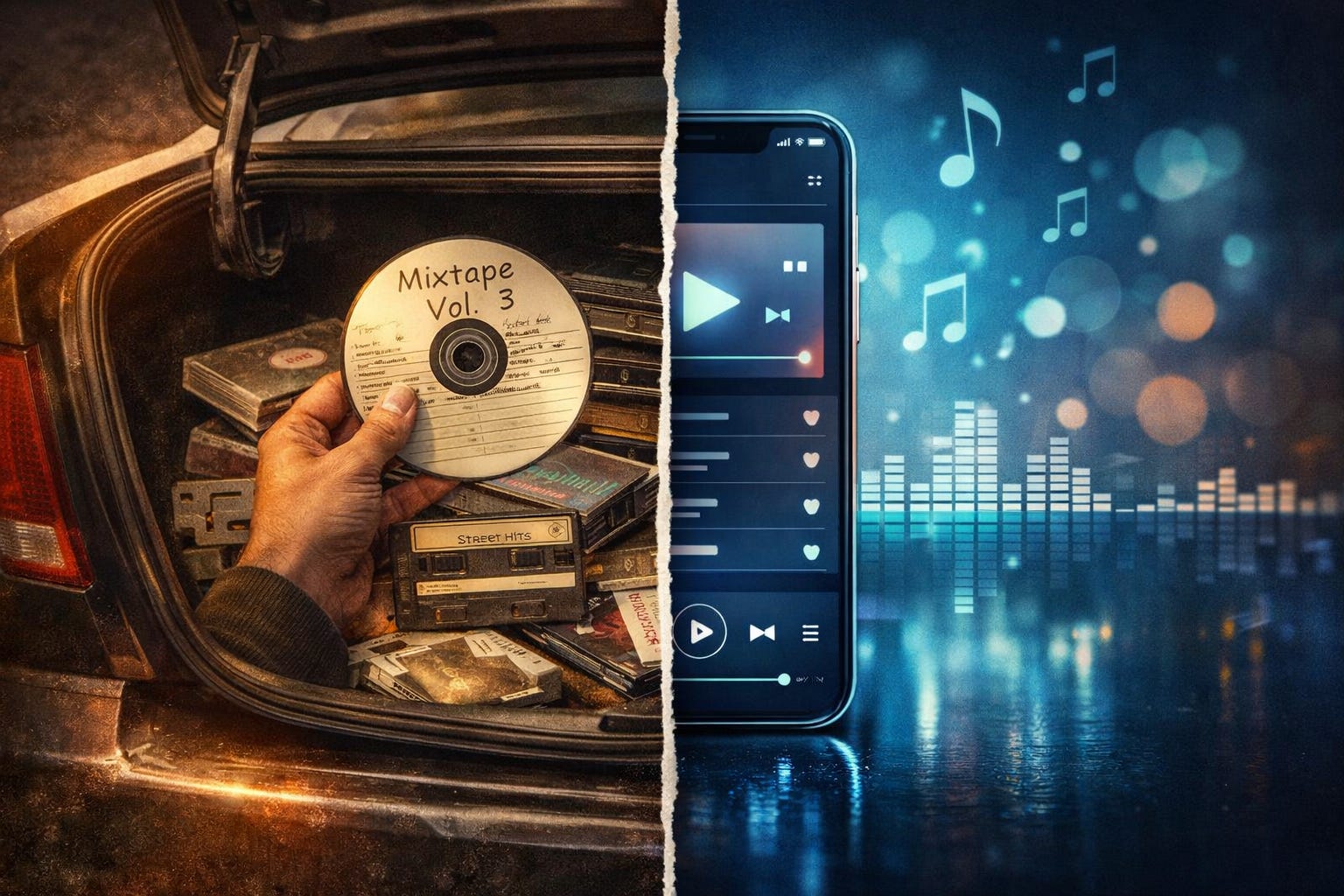
The mixtape didn’t die.
It got cleaned up, cleared for samples, and sold back to us for $9.99 a month.
Everything the music industry now calls “streaming strategy”—constant drops, bloated tracklists, blurry lines between albums and side projects—was already perfected years earlier. Not in boardrooms. In trunks. On burned CDs. On DatPiff links that crashed servers at midnight.
The mixtape was never just a format.
It was an operating system.
For years, labels treated it like a problem. A gray market. A legal headache. In 2007, the Feds literally raided DJ Drama like he was running an organized crime ring—for distributing the same kind of music major-label artists now drop weekly to juice algorithms.
Fast-forward to now, and that same industry depends on the logic it once tried to destroy.
Spotify didn’t invent the content flood.
Hip-hop did.
The Panic That Gave It Away
In early 2023, hip-hop felt a rare kind of fear—not over beef, not over leaks, but over loss.
DatPiff was rumored to be shutting down.
For over fifteen years, the site functioned as a digital public library for rap music. Hundreds of thousands of mixtapes. Careers launched. Regional sounds preserved. When outages hit, fans and archivists realized how fragile the whole thing was. Roughly 366,000 mixtapes—about 50 terabytes of culture—were suddenly at risk of disappearing.
They had to be rushed to the Internet Archive to survive.
That panic exposed something streaming tries very hard to hide: the promise that “everything is available” is mostly fiction. Especially when it comes to hip-hop. Especially when it comes to mixtapes.
The files are endangered.
The system they built is not.
When a Mixtape Was a Physical Threat
Before “mixtape” became branding, it was literal.
In the 1970s, DJs like Kool Herc used cassette decks to record live party sets in New York. These tapes weren’t collectibles. They were survival tools—ways to capture moments and move them through neighborhoods that the industry ignored.
By the 1980s and ’90s, that system expanded. DJs and regional legends pressed tapes and CDs in bulk, creating parallel distribution networks in cities like Compton, Houston, and Atlanta. This wasn’t underground culture for culture’s sake. It was business.
By the late ’90s and early 2000s, the mixtape economy was fully operational.
DJs like Clue and Doo Wop weren’t just blending records. They were breaking artists. Exclusive freestyles became leverage. A hot verse on the right tape could force a label’s hand.
This was the gray market—technically illegal, culturally essential, wildly profitable.
“Promo only” was the polite explanation.
Cash in the trunk was the real one.
The Myth of “Free”
The industry loves to rewrite this part.
Yes, mixtapes helped artists build buzz. Yes, 50 Cent’s Guess Who’s Back? turned street momentum into a major-label deal. That part is real.
But the idea that mixtapes were never about money is a lie we’ve repeated long enough to believe.
DJs moved serious units. Entire street teams lived off the margins. And rappers weren’t chasing streams—they were chasing attention at scale. Attention they controlled.
By the mid-2000s, the mixtape stopped being a DJ’s product and became an artist’s weapon.
Rappers hijacked other people’s beats to bypass label red tape. They dropped full projects without permission. They sounded raw on purpose. Unfiltered meant authentic. Messy meant real.
Dropping a free tape wasn’t generosity.
It was proof of life.
The Raid That Changed Everything
The mixtape era didn’t fade out.
It got raided.
On January 16, 2007, police stormed the studios of DJ Drama and Don Cannon in Atlanta—the architects of Gangsta Grillz. Officers seized roughly 50,000 CDs. Drama and Cannon were hit with racketeering charges under Georgia’s RICO statute.
Same laws used for organized crime.
The message was loud: if they can lock up Drama, nobody’s safe.
This was the industry’s great contradiction. Labels were quietly benefiting from the mixtape circuit while publicly treating it like a criminal enterprise. Drama wasn’t a bootlegger. He was working directly with major-label artists, helping them break records.
Didn’t matter.
Drama’s accounts were frozen. He was left with nothing. And the physical mixtape economy—the trunks, the streets, the CD-R hustle—collapsed almost overnight.
The industry thought it won.
It didn’t.
When the Trunk Became a Server
Once the streets closed, the culture moved online.
DatPiff, LiveMixtapes, and early hip-hop blogs stepped into the vacuum. The Blog Era didn’t invent the mixtape—it scaled it nationally. Regional hustle went global overnight.
The business model was simple: free music, ad revenue, attention as currency.
Sound familiar?
DatPiff was an early prototype of streaming, even if no one wanted to admit it at the time. Massive libraries. Zero cost to fans. Monetized eyeballs.
By 2010, the impact was undeniable. Wiz Khalifa’s Kush & Orange Juice crashed the internet. Big K.R.I.T. turned blog buzz into a Def Jam deal. The gatekeepers changed, but the rules stayed the same.
Flood the market. Stay visible. Control the narrative.
When Streaming Made It Official
By the mid-2010s, the argument was over.
Streaming didn’t kill the mixtape.
It absorbed it.
Artists realized the word “mixtape” could lower expectations, bypass contracts, or justify nonstop releases. Drake called If You’re Reading This It’s Too Late a mixtape—while selling it like an album. The distinction stopped mattering.
What mattered was output.
Streaming platforms needed constant content to survive. Mixtapes had already solved that problem years earlier. The industry finally adopted the system it once tried to criminalize.
By the late 2010s, classic mixtapes were being cleared and uploaded to streaming services to monetize nostalgia. So Far Gone. Acid Rap. History—edited for legality.
What Didn’t Make the Jump
Streaming came with rules. Mixtapes thrived without them.
The magic of the mixtape era was freedom—rapping over anything, sampling everything, asking no one for permission. Streaming platforms enforce copyright aggressively, which turns many classic tapes into legal nightmares.
When Acid Rap hit streaming, fan-favorite tracks were missing. Others arrived altered. Ghosts of songs replaced by silence.
Some projects never made it at all.
What survived was the system.
What got lost was the chaos.
The Beta Test We Didn’t Recognize
Looking back, the mixtape economy wasn’t a detour. It was a beta test.
Direct-to-fan distribution. Bypassing gatekeepers. Relentless output. Branding over format. Attention as currency.
That’s the modern music industry.
Playlist culture. Surprise drops. Algorithm chasing. All echoes of a hustle perfected long before streaming apps existed.
We didn’t trade the mixtape era for something new.
We traded it for something cleaner—and more controlled.
The revolution wasn’t televised.
It was uploaded, cleared for samples, and added to your playlist.
Sources & Further Reading
DatPiff, Archiving, and the Blog Era
This Was Almost an Obituary for DatPiff — The FADER (2023)
https://www.thefader.com/2023/03/24/datpiff-almost-shut-down-mixtape-archiveA Generation of Hip-Hop Was Given Away for Free. Can It Be Archived? — Pacific Standard (2019)
https://psmag.com/ideas/a-generation-of-hip-hop-was-given-away-for-free-can-it-be-archivedWe Used to Sell Mixtapes: An Interview with KP Reilly of DatPiff — Passion of the Weiss (2014)
https://www.passionweiss.com/2014/05/16/we-used-to-sell-mixtapes-an-interview-with-kp-reilly-of-datpiff-com/DatPiff Archive on the Internet Archive
https://archive.org/details/datpiff-archive
Mixtapes as an Industry (Pre-Streaming)
‘Criminal Minded?’ Mixtape DJs, the Piracy Paradox, and Lessons for the Recording Industry — Tennessee Law Review (2008)
https://papers.ssrn.com/sol3/papers.cfm?abstract_id=1106624Mixtape — Wikipedia (background reference)
https://en.wikipedia.org/wiki/Mixtape50 Cent’s Mixtape Blueprint — Billboard
https://www.billboard.com/music/rb-hip-hop/50-cent-mixtape-history-8474924/
The 2007 DJ Drama Raid
DJ Drama Arrested in Mixtape Raid — NPR (2007)
https://www.npr.org/2007/01/18/6910518/dj-drama-arrested-in-mixtape-raidMixtape DJs Face RICO Charges — Billboard
https://www.billboard.com/music/music-news/mixtape-djs-face-rico-charges-1054818/
Blog Era → Streaming Transition
Bringing Back the Blog Era — Boardroom (2023)
https://boardroom.tv/bringing-back-the-blog-era/How Wiz Khalifa Became a Star Without Radio — Billboard
https://www.billboard.com/music/rb-hip-hop/wiz-khalifa-career-breakthrough-8474840/How Big K.R.I.T. Broke Through the Blog Era — Billboard
https://www.billboard.com/music/rb-hip-hop/big-krit-career-blog-era-8475021/
Streaming, Mixtapes, and the Blurred Line
Why Albums and Mixtapes Don’t Mean the Same Thing Anymore — Dictionary.com
https://www.dictionary.com/e/slang/mixtape/Spotify for Artists: The Evolution of Music Releases
https://artists.spotify.com/blog/release-strategyDrake’s “If You’re Reading This It’s Too Late” and the Commercial Mixtape — Billboard
https://www.billboard.com/music/music-news/drake-if-youre-reading-this-its-too-late-6465922/
Preservation, Scarcity, and Alternatives
Nipsey Hussle’s Proud2Pay Experiment — Forbes / The Guardian (2013)
https://www.forbes.com/sites/zackomalleygreenburg/2013/10/16/nipsey-hussle-crenshaw/Mixtape: The Movie — HipHopDX (2023)
https://hiphopdx.com/news/mixtape-documentary-premiere
