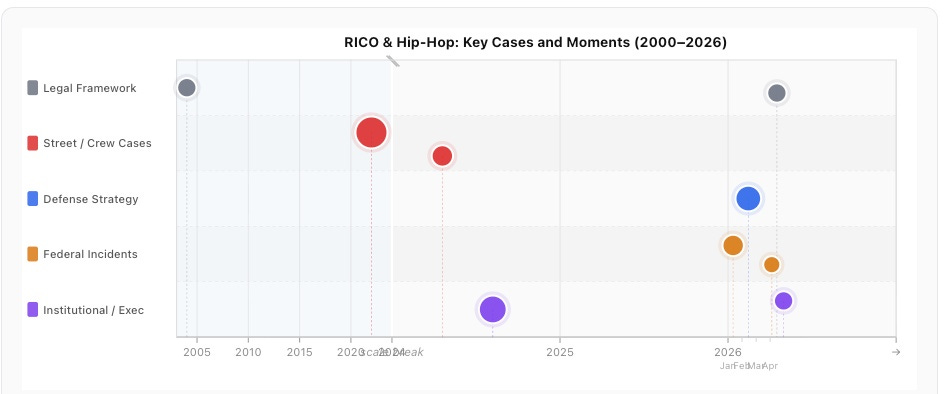
Snitching used to be simple. You stayed solid or you didn’t, and the proof lived in sealed court files, block whispers, and who was still allowed to come outside. RICO changed that math. When prosecutors started treating rap collectives like organized crime — from YSL in Atlanta to the way Lil Durk’s Instagram posts get framed as “overt acts” — cooperation stopped being a purely moral decision. It became a survival tool, a bargaining chip, a thing to weaponize in court and on camera. Lawyers go hunting for proffer agreements. The FBI quietly tracks calls. YouTube paperwork channels turn discovery into programming.
This isn’t a story about who snitched. It’s about how RICO-era pressure is forcing hip-hop to renegotiate what snitching even is — in the courts, in the culture, and in the content economy that now lives off both.
The Old Code Meets the New Statute
Before anybody said “RICO” on a record, hip-hop already had a legal relationship with the state: raids, gun charges, drug cases, parole violations. The street rule was straightforward — no cooperation, no statements, no paperwork with your name next to the words “government witness.” What’s different now isn’t just the scale of charges. It’s the architecture. RICO — and its state variants — doesn’t just go after a single act. It goes after a pattern attached to an enterprise. In practice, that means prosecutors don’t have to prove every underlying offense at trial. They just have to show an ongoing scheme with a set of people connected to that scheme.
When the bar shifts from proof of a specific act to a pattern tied to a group, the value of cooperation skyrockets. So does the risk of standing next to the wrong person in a photo. The old code was built for individual cases. The new statute is built for networks. [AllHipHop]
YSL: When a Collective Becomes a Conspiracy
The Young Thug/YSL case is the blueprint for how this plays out in rap. A sweeping indictment tied to alleged gang activity inside a music collective became the longest and most expensive criminal trial in Georgia history, eventually wrapping in late 2024 through a plea deal that included probation and credit for time served. YSL wasn’t just described as a label or crew — it was cast as an enterprise, with music, money, and alleged violence braided into a single legal narrative. The case is now widely cited for showing how quickly a music career can get pulled into the federal system.
That framing did two distinct things. First, it turned association into liability. If you’re YSL on paper, or adjacent in public, your day-to-day life becomes potential “pattern” evidence. Lyrics, chains, hand signs, Instagram captions, who you stand next to in a club — it all becomes context the prosecution can use to anchor an enterprise theory. Second, it turned cooperation into a narrative economy. Young Thug publicly fought “snitch” narratives after viral police audio surfaced, posting that they didn’t play his interrogation footage in court because “I helped my brada” — mocking the idea that he had cooperated. [AllHipHop] Leaked jailhouse audio had him blasting Gunna for allegedly characterizing YSL as a gang in statements to prosecutors: “He said YSL is a gang… That’s RICO. So if a n***a get found guilty on RICO… you got a n***a life took.” [AllHipHop]
Whether those quotes are fully contextualized or not, they reveal the central pressure point: in a RICO case, how you describe the group — gang vs. label, friends vs. enterprise — is itself cooperation or resistance. The YSL case forced the culture to debate publicly what it had always handled privately. When does surviving the case mean betraying the code?