


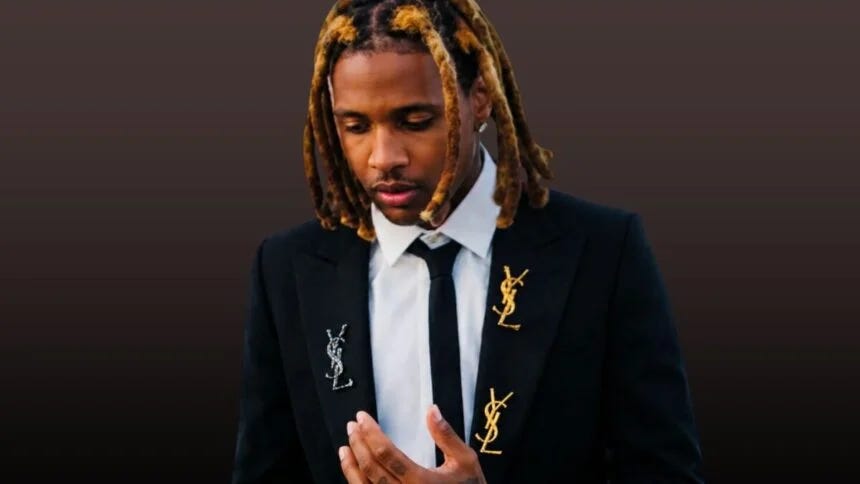
The Two Trials of Lil Durk
Federal prosecutors are not trying to prove Durk Banks pulled a trigger. They are trying to prove that grief became an order, and that a shelved music video was a rehearsal. One of those cases is ordinary. The other could change how rap gets prosecuted.
A note before you read: Durk Banks has pleaded not guilty and is presumed innocent. Everything below is an allegation, an item of evidence, or an argument made by one side in an ongoing federal trial. The cooperating witnesses quoted here are testifying under plea deals that reward them for it. No verdict has been reached.
There are two trials happening inside the same Los Angeles courtroom, and Durk Banks is the defendant in both. The first is a fairly conventional federal murder-for-hire case: cooperators, phone records, flights on a credit card, the ordinary machinery of a conspiracy prosecution. The second is something bigger and stranger, a case in which the government asked a jury to watch an unreleased music video and see a confession. How those two trials resolve, and which one the jury leans on, is the whole story.
The government’s theory is grief turned lethal. When Durk’s close friend and OTF labelmate King Von was killed in November 2020, prosecutors say the mourning curdled into a plan for revenge against the rapper Quando Rondo, whose associate had shot Von. On August 19, 2022, a crew that traveled from Chicago opened fire on a vehicle near the Beverly Center. Rondo, legal name Tyquian Bowman, survived. His 24-year-old cousin, Saviay’a “Lul Pab” Robinson, did not. The man the government says financed and ordered it never touched a gun. That is the case.
What Durk is actually charged with
Banks faces federal counts including conspiracy, use of interstate facilities to commit murder-for-hire resulting in death, firearms offenses involving a machine gun, and a stalking count added by a later indictment. [Forbes] He was arrested in October 2024, has been denied bail repeatedly, and has sat in federal custody ever since. Prosecutors have said they will not seek the death penalty; the maximum is life. He has assembled a heavyweight defense led by Atlanta attorneys Drew Findling and Brian Steel, the latter fresh off the Young Thug case. [Billboard]
The story built from artifacts
For much of the trial the government’s case was assembled out of things rather than people. Jurors saw private texts from the night Von died, in which Banks wrote that the loss had turned him into, in his words, a different animal, and that he could not let it slide. They heard a 2021 podcast clip in which 6ix9ine and Wack 100 needled him publicly for failing to retaliate, offered as proof that the pressure to answer was social, not just personal. And they watched an unreleased 2021 video for a song called “Redman,” in which Banks reads news of Von’s death and then chases and shoots an actor prosecutors say was meant to represent Rondo. [Rolling Stone]
All of it is circumstantial, and all of it is about what was in a grieving man’s head. The defense answer to every piece is the same sentence: that is what artists make. Grief is not a plan. A man saying he is dead inside is not a man commissioning a killing.
If a shelved music video is going to help convict a man of murder, that reasoning does not stay in this courtroom. Every prosecutor with a defendant who raps will cite it.
The oldest fight in rap prosecutions
The “Redman” video is where the second trial lives. For years, artists, academics, and civil-liberties groups have fought the practice of admitting rap lyrics and videos as evidence, arguing it lets prosecutors read genre convention as autobiography in a way no one applies to other art forms, and that it leans on jurors’ assumptions about young Black men. Usually the defense has a strong answer: a released record is a product with a persona attached, a character speaking to an audience.
What makes this video a harder case is that it was never released. Unreleased footage sitting on a hard drive has no audience to perform for, which is exactly why the government wants it. The defense counters that plenty of art gets shelved, and that Steel landed the sharpest point of the week when he noted investigators never once contacted the video’s producer or label to ask what the concept was. If a piece of creative work is going to function as evidence of a murder, the people who made it are witnesses. Not calling them is a choice.
The men who say they were there
The government knows artifacts get you to motive, and motive is not a crime. To get to an order, it needed people. Three men who have pleaded guilty took the stand for the prosecution, and each placed Banks at a different point in the chain. Kacey “OTF Jam” Hester, one of the masked gunmen, testified the instruction and the money came from Banks. Kavon “OTF Vonnie” Grant, Durk’s former personal assistant, gave the shortest answer of the trial when asked why the crew targeted Rondo: [The Source] “Durk told us to.” A third cooperator relayed a $1 million bounty figure, though notably he did not claim to have heard it from Banks himself.
Then the defense went to work, because a case built on cooperators is only as strong as the men holding it. Under cross, Hester was confronted with a 2023 recording in which he had told federal officers the opposite of his testimony, walked through a violent criminal history, and offered a line that will outlive the trial: asked about theft, he corrected the lawyer, “Steal? I call it taking.” [Los Angeles] Most consequentially, reporting from the cross indicates Hester conceded that much of what he says about Banks specifically rests on his word alone. Every one of these men is testifying under a deal that rewards him for it. That is the hole the defense spent two weeks widening.
The part with no music in it
The steadiest thread in the government’s case has nothing to do with art. Investigators cracked the case not through lyrics but through a pair of pants: surveillance footage from an In-N-Out about half an hour after the shooting caught a man whose black pants read “Rats to Riches,” a phrase a detective typed into Google that led to a Chicago shop, an ID, and the crew. [AllHipHop] From there came travel booked on a credit card and, most damaging of all, a single text from Banks: don’t book any flights under names connected to him.
That sentence is doing more work than the video ever could. It is not artistic expression, it is not open to a genre reading, and it is hard to explain as anything but awareness. Whether it proves he directed the plot or merely knew about it is the question the whole case turns on, and it is why the cooperators mattered so much.
Where it stands, and why it matters
As of this week, both sides have rested. The government closed out its case with agents describing what prosecutors call Banks’s attempted flight from a South Florida airport, and the defense answered briefly, calling witnesses who tried to discredit the cooperators and to reframe the flight, the “lay low” instructions, and the flights text as something short of a murder plan. [AllHipHop] Closing arguments are being scheduled, and the case is expected to reach the jury within days.
Here is why the two trials point in different directions. If jurors convict on the cooperators and the paper trail, this becomes a conventional federal murder-for-hire case and the video is a footnote. But if they cannot trust men who admit to two killings and testify for a deal, and the government leans harder on “Redman” to fill the gap, then a shelved music video becomes load-bearing in a murder conviction. That precedent would not stay in Los Angeles. The industry knows it, which is part of why Ye and Machine Gun Kelly have turned up in the gallery. This was never only about one rapper. It is about whether the things artists make can be turned into the case against them.
We are covering this trial day by day as it unfolds, from the King Von texts and the shelved video through every cooperator, the brutal cross-examinations, and the road to a verdict. For the full timeline, the evidence, and each day’s testimony:
Lil Durk’s Federal Murder-for-Hire Trial: Full Coverage → history.hiphop
Ask Hip-Hop covers the culture as a living thing, not a headline. If this is your first time here, subscribe for the stories behind the stories.